
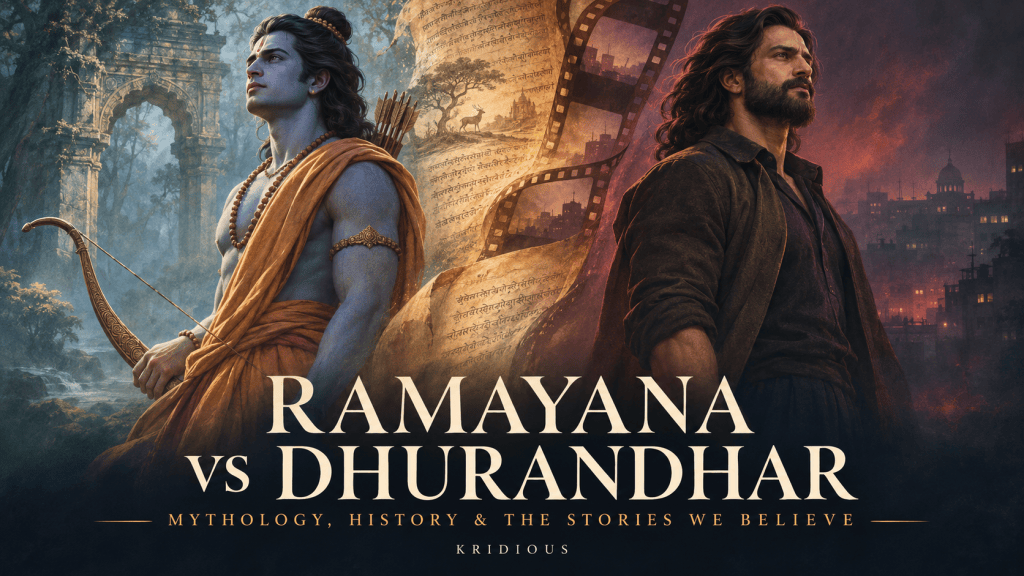
Two cinematic spectacles, two philosophies of power, and the uncomfortable double standards of the Indian audience
By Rishabh Dubey “Kridious”
17 November 2026
There is something peculiar about a generation that demands textual fidelity from mythology but seldom demands comparable fidelity when fiction borrows the authority of recent history.
In Indian cinema, that contradiction has found two spectacular expressions: Nitesh Tiwari’s Ramayana and Aditya Dhar’s Dhurandhar duology. One revisits a story that has survived precisely because successive generations found new ways to tell it. The other stitches events from within living memory into an audacious universe of espionage, political intrigue and revenge.
Both are immense cinematic undertakings. Both demonstrate technical ambition of a kind Indian filmmakers can rightfully celebrate. And both deserve to be judged as films, including for the liberties they take.
It is worth clarifying what mythology means here. The word is not a polite synonym for falsehood. It describes a realm of sacred and culturally foundational narratives that can express truths about duty, grief, temptation and human character whether or not they are treated as modern historical chronicles. For many devotees, the Ramayana is also itihasa, sacred history. Those convictions need not be dismissed to recognize that the epic’s moral significance exceeds any single question of archaeological proof.
Yet a curious asymmetry runs through parts of the conversation surrounding them. An ancient epic is subjected to the scrutiny of an imagined, immutable original; a contemporary thriller is often received with the exhilaration of history finally revealing its secrets. We question whether Sita may call her husband Ram, yet seldom pause with the same intensity over whether a modern political event actually unfolded as an action screenplay suggests.
The problem is not creative freedom. It is our selective appetite for truth.
Three Hundred Ramayanas and the One We Think We Know
The first difficulty with demanding that Ramayana adhere to the “original” is deciding what we mean by that word.
Valmiki’s Ramayana occupies a foundational place in the tradition. But the Rama story has travelled through Sanskrit, Tamil, Awadhi and countless other literary and oral worlds, through Hindu, Jain and Buddhist traditions, and across Southeast Asia. A. K. Ramanujan’s celebrated essay Three Hundred Ramayanas did not provide an exact census of sacred books. It showed how an enduring narrative acquires distinct voices, emphases and meanings without ceasing to be recognizably itself.
Kamban’s Tamil Ramavataram is not Tulsidas’s Ramcharitmanas. Nor are either identical to Valmiki’s Sanskrit poem. In some Jain tellings, Lakshmana kills Ravana, while Rama ultimately renounces worldly life. If such differences can inhabit the history of the tradition, it is difficult to argue that every variation in a film must constitute a betrayal.
Consider Sita. Her portrayal as an active fighter in Tiwari’s film has attracted objections on the ground that she was never a warrior. Yet the Adbhuta Ramayana, traditionally attributed to Valmiki but not securely established as his own composition, places Sita at the centre of the narrative and associates her with Kali’s overwhelming power. In that telling, she defeats a formidable Ravana whom Rama cannot vanquish. The film’s particular fight choreography need not be a literal reproduction of that text for the broader point to stand: a fierce Sita is hardly inconceivable within the Ramayana tradition.
Even the objection to her addressing Rama as “Ram” deserves perspective. Valmiki’s Sita calls out Rama’s name when she is carried away by Ravana. That does not settle every question about the dialogue appropriate to a particular scene, but it does make the notion that the name itself is inherently impermissible difficult to maintain.
Then there is Ravana. In Valmiki’s account, his desire for Sita is central to the abduction; the humiliation of Surpanakha and the destruction of his forces also shape the unfolding conflict. A film that foregrounds family grievance and revenge changes the balance of motives, and a viewer is entitled to question whether that change serves the story. But presenting Ravana as intelligent, learned, devoted to his family or capable of affection is not automatically to absolve him of wrongdoing. A villain does not become morally innocent merely because he is not emotionally one-dimensional.
Plurality is not a license for careless adaptation. The philosophical integrity of a sacred story matters. But there is a difference between arguing that an adaptation misses the spirit of an epic and announcing that every unfamiliar detail is an invention. Too often, the “authentic Ramayana” being defended seems less like a specific text than a composite memory of childhood readings, televised performances and inherited expectations.
Perhaps the pertinent question is not whether the filmmakers have read Valmiki. It is whether their loudest critics have distinguished Valmiki from the version they first saw on a screen.
Sita’s Courage and Rama’s Maryada
The richer defence of Sita does not actually require a sword.
In Aranya Kanda, Sarga 9 of the Valmiki Ramayana, Sita cautions Rama against violence without provocation. She tells a story about an ascetic corrupted by his association with a weapon and questions the moral danger of treating the capacity to kill as sufficient reason to do so. Rama, in the following chapter, answers from the standpoint of his duty to protect endangered sages. What emerges is not a passive wife reciting obedience but a woman capable of moral reasoning, respectful disagreement and intellectual courage.
Long before contemporary cinema placed a weapon in Sita’s hands, Valmiki placed an argument in her voice.
Rama’s response to power is equally instructive. In Yuddha Kanda, Sarga 80, an enraged Lakshmana proposes using a Brahma weapon to destroy the Rakshasas while confronting Indrajit. Rama stops him. It is unjust, he explains, to destroy an entire group for the sake of defeating one adversary. He goes further, identifying people who ought not be killed: those who are not fighting, who are fleeing, who seek refuge or are otherwise defenseless.
This is no sentimental refusal to confront evil. Rama wages war, employs formidable weapons and ultimately defeats Ravana. His moral distinction is not that he never fights; it is that righteous purpose does not exempt him from the obligation to discriminate, deliberate and restrain himself. The passages belong to the larger epic, including events beyond the first 2026 film, but they illuminate the ideal that the character is meant to embody.
Maryada is sometimes mistaken for meekness. It is closer to the difficult discipline of possessing the power to act and accepting limits upon how that power may be used. Rama is revered as Maryada Purushottam not because victory comes easily to him, but because the manner of victory matters.
Imagine measuring heroism only by the speed or scale of an enemy’s destruction. Under that definition, restraint appears weak. The Ramayana asks us to consider the opposite possibility: that the refusal to turn justified anger into indiscriminate force is among the highest forms of strength.
When Fiction Borrows History’s Authority
Dhurandhar operates in another narrative territory, and it occupies that territory with considerable flair. Aditya Dhar’s films are gripping, frequently brutal and technically accomplished. Their music, editing, performances, action design and command of suspense make the experience far more immersive than a dry catalogue of events could ever be.
The duology also performs a subtler feat. It takes recognizable historical traumas and political developments—among them the IC-814 hijacking, the Parliament attack, 26/11, and the 2016 demonetisation—and positions them within a fictional intelligence narrative. Real incidents furnish the emotional and chronological scaffolding; invented operations and characters provide the connective tissue.
The sequel expressly states that it is not a documentary and that people, institutions and events have been fictionalized or dramatized. That distinction matters. The filmmakers are entitled to create fiction, and audiences are entitled to enjoy it.
But what happens when the invented connective tissue becomes more memorable than the documented events it connects?
Demonetisation offers a revealing example. In the film’s fictional universe, the withdrawal of high-value currency is bound into an intelligence story about counterfeit notes and hostile networks. Fighting fake currency and terrorism financing were indeed among the Indian government’s publicly declared objectives in November 2016. What is not thereby established is the particular hidden plot and decisive chain of events imagined by the screenplay.
The historical record is more complicated. According to the Reserve Bank of India’s 2017–18 annual report, approximately ₹15.31 lakh crore of the ₹15.42 lakh crore in specified banknotes circulating at the time was returned—roughly 99.3%. Those figures do not, by themselves, prove that demonetisation failed to affect counterfeiting, financing or other policy objectives. They do, however, show why an expansive policy decision cannot be adequately understood through the tidy resolution of a fictional spy operation. Its economic consequences, human costs and contested outcomes cannot be folded into one cinematic revelation.
Similarly, the sequel’s fictional gangster-politician evokes the 2023 killing of Atiq Ahmed, while adding alleged connections to counterfeit networks that have not been established by the available public record. The resemblance to a documented event gives the invented story dramatic force; it does not transform its added allegations into history.
There is a difference between dramatizing what happened and supplying what appears to be the missing explanation for why it happened. The second can be extraordinarily persuasive precisely because it makes a complicated world seem suddenly comprehensible.
The Machinery of Rage
There is nothing inherently inferior about revenge as a storytelling device. From classical tragedy to modern thrillers, retaliation has powered some of cinema’s most compelling narratives. Tarantino-like excess, abrasive dialogue, shocking reversals and spectacular violence are legitimate aesthetic choices. Dhurandhar uses them expertly, often combining anguish, anticipation and release in a rhythm that keeps audiences hungry for the next confrontation.
Its emotional mechanism is easy to recognize: show the wound, deepen the wound, make the viewer wait, and finally offer the satisfaction of retaliation. The release is visceral. The audience has not merely watched the protagonist defeat an adversary; it has been invited to feel that the suffering preceding the violence has justified the violence that follows.
That is powerful cinema. It is also worth examining.
The Ramayana certainly contains anger, warfare, grievous loss and fierce battles. Dhurandhar contains sacrifice, loyalty, intelligence and disciplined strategy. The contrast is not between an entirely peaceful epic and a film devoid of moral feeling. It is between their dominant ideas of what power is for, and how a story rewards its exercise.
In one tradition, an ethical question continually shadows force: even when the cause is just, what must remain forbidden? In the other, the anticipation of striking back supplies much of the dramatic momentum. One asks what righteousness requires of a powerful person. The other repeatedly demonstrates how intoxicating the defeat of an enemy can feel.
And this leads to a question larger than either film: have we begun confusing the satisfaction of seeing an enemy destroyed with the satisfaction of seeing justice done?
What We Remember After the Credits
Cinema does not merely present information. It arranges images, sounds and emotions into experiences our memories retain. That is part of its beauty—and, when recent history is involved, part of its responsibility.
Research on historical films has found that viewers can absorb inaccurate details into their recollection of real events. In one study published in Psychological Science, specific warnings about inaccuracies helped reduce this effect, while broad cautions did not always prevent mistaken recall. This is evidence about historical films in general, not proof that Dhurandhar has changed any particular viewer’s beliefs. But it makes the concern more than a rhetorical flourish.
A disclaimer can state that a film is fictional. It cannot guarantee that an emotionally convincing four-hour experience will be remembered with all its factual boundaries intact.
That matters particularly when a story draws upon national tragedies and the grief of real victims. Historical fiction owes no obligation to reproduce every official chronology. It does, however, invite greater care when its invented causality is likely to be mistaken for a hidden truth finally brought to light.
The irony is difficult to ignore: some of us approach a mythological epic with the suspicion of a historian and a historically inspired thriller with the credulity of a believer.
Beyond the Hindi Box Office
The market response reveals another dimension of the discussion. Both films have been enormous commercial achievements, but their language-wise performance is notably different.
During their respective second Friday-to-Sunday weekends—Days 9 to 11—Dhurandhar 2 earned an estimated ₹158.50 crore net in its Hindi version, ahead of Ramayana‘s ₹145.25 crore. Yet the comparison reverses outside Hindi. The four other language versions of Ramayana contributed approximately ₹50.75 crore that weekend, against ₹14.20 crore for Dhurandhar 2. Across all five language versions, Ramayana earned an estimated ₹196 crore against ₹172.70 crore.
| Language version | Ramayana, second weekend | Dhurandhar 2, second weekend |
|---|---|---|
| Hindi | ₹145.25 crore | ₹158.50 crore |
| Kannada | ₹14.15 crore | ₹0.90 crore |
| Telugu | ₹11.35 crore | ₹9.00 crore |
| Tamil | ₹12.25 crore | ₹3.80 crore |
| Malayalam | ₹13.00 crore | ₹0.50 crore |
| All India, net | ₹196.00 crore | ₹172.70 crore |
Source: Sacnilk day-wise trade estimates, compared at the same release stage; figures available as of 17 November 2026.
Non-Hindi versions thus supplied roughly 25.9% of Ramayana‘s second-weekend Indian net collections, compared with about 8.2% for Dhurandhar 2. That is evidence of a broader dubbed-language contribution at this stage, not proof of universal affection or superior artistic merit. Casting, regional star power, screen availability, pricing and promotion also matter. International criticism of Ramayana, moreover, has been mixed rather than uniformly adulatory.
Still, the figures complicate any attempt to equate the Hindi-speaking market’s preferences with the preferences of all Indian filmgoers. Indian cinema is a conversation among many languages, and the most productive response to that diversity is curiosity rather than defensiveness.
Making History and Remaking It
There is another temptation worth resisting: the idea that a film’s place in history is settled by the number of crores it earns. Revenue establishes commercial records; cinematic legacy also depends on artistry, influence and the conversations a work leaves behind. A blockbuster can accomplish all three, but the achievements are not identical.
Nor must we choose between these two films to appreciate the accomplishment of either filmmaker. Tiwari is entitled to assemble an epic from a living inheritance of interpretations. Dhar is entitled to transform the materials of recent history into a heightened thriller. Neither privilege should make the films immune to criticism.
What audiences owe them—and themselves—is consistency. If we are going to question a line of dialogue, a change in motive or a warrior’s portrayal because the source matters to us, surely the sources behind a political claim or a recognizable national tragedy deserve scrutiny too.
Rama’s greatness was never merely that he could destroy an enemy. It was that the ability to destroy did not remove his duty to choose wisely. Dhurandhar reminds us how exhilarating retaliation can be; the Ramayana reminds us why power, even when exercised for a righteous cause, must answer to principles beyond exhilaration.
One need not diminish the cinematic spectacle of either to recognize that distinction. One need not reject revenge thrillers to question their historical implications. And one need not believe that every Ramayana adaptation is faithful to recognize that faithfulness to an epic is more complicated than a remembered television scene.
Some films make history through the records they break. Others can remake history in the minds of those who watch them.
The difference may not always be visible on the screen. It often reveals itself in what we believe after leaving the theatre.
Sources and further reading
- A. K. Ramanujan, “Three Hundred Ramayanas,” in Many Ramayanas: The Diversity of a Narrative Tradition in South Asia, edited by Paula Richman. University of California Press; Oxford Bibliographies overview.
- Valmiki Ramayana, Aranya Kanda, Sarga 9 (Sita on violence), and Yuddha Kanda, Sarga 80 (Rama restraining Lakshmana). IIT Kanpur Ramayana text; Yuddha Kanda, Sarga 80.
- Katie Work, The Adbhuta and the Sītāyaṇa Tradition, Lancaster University, 2021. Research overview.
- The Indian Express, “How Dhurandhar 2 uses real-life events—from demonetisation to encounters—to build Hamza’s world,” 20 March 2026. Article.
- Government of India, Prime Minister’s address on demonetisation, 8 November 2016. Primary record. Reserve Bank of India, Annual Report 2017–18. Primary record.
- Butler et al., “Using Popular Films to Enhance Classroom Learning: The Good, the Bad, and the Interesting,” Psychological Science, 2009. PubMed abstract.
- Sacnilk, Ramayana daily and language-wise collections and Dhurandhar: The Revenge daily and language-wise collections.
- Mircea Eliade, “Cosmogonic Myth and ‘Sacred History’,” Religious Studies, 1967, on myth as sacred narrative rather than simply fiction. Cambridge University Press.


Leave a Reply