
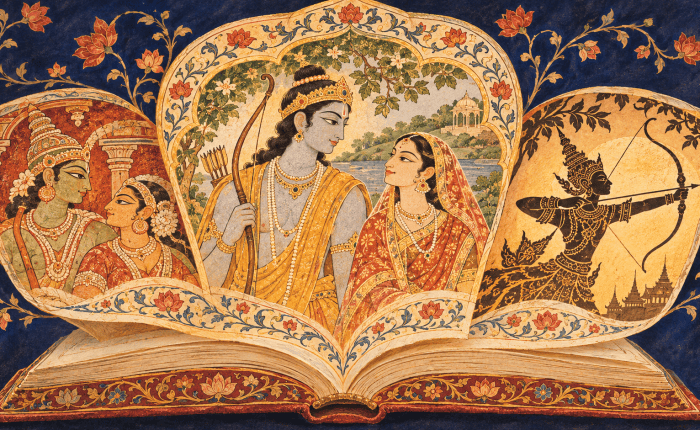
On sacred stories, selective memory and the courage to read
By Rishabh Dubey “Kridious”
Some of us can recognise an insult to the Ramayana faster than we can recognise a passage from it.
We inherit its names, images and moral vocabulary. We encounter it in family conversations, festivals, television and cinema. Then, sometimes, familiarity becomes certainty, and certainty becomes a licence to decide what everyone else may say. Before condemning a telling for departing from “the Ramayana”, however, we owe the tradition a basic question: which Ramayana do we mean?
Surely a tradition this old deserves to be understood beyond the version we happened to grow up with.
How many versions of the Ramayana are there?
There are hundreds of Ramayana tellings, but no agreed final count. A. K. Ramanujan’s celebrated essay, “Three Hundred Ramayanas”, cautions against taking its title as a literal total. The number changes depending on whether we count complete literary works, translations, manuscript copies, oral narratives, songs or performances. “Thousands” may describe that vast narrative world; it is not a verified inventory of thousands of distinct, complete books. [1]
If I am going to question somebody else’s certainty, I cannot begin by inventing a number of my own.
Kamban and the Adbhuta Ramayana
Consider Kamban, also written Kampan, whose medieval Tamil Iramavataram, commonly called the Kamba Ramayanam, is far more than a change of language. It is a major poetic and devotional creation. Kamban’s six-book epic ends with Rama’s coronation; the Tamil Uttara Kanda associated with it is a separate work attributed to Ottakkuttan. Even the familiar shape of a “complete Ramayana” changes when we move between literary traditions. [2]
Sita kills Ravana in the Adbhuta Ramayana
Then consider the Sanskrit Adbhuta Ramayana, a later work traditionally attributed to Valmiki, distinct from the familiar Valmiki epic. Here, Sita assumes a terrifying divine form associated with Kali and kills a thousand-headed Ravana. The woman often remembered primarily through abduction, endurance and trial becomes the decisive power of the narrative. This is a Shakta vision of Sita’s supremacy, preserved within the history of Ramayana literature. [3]
The Ramayana across religions and beyond India
Jain Rama narratives can rearrange the ethical centre even more dramatically: in the tradition discussed by Ramanujan, Lakshmana kills Ravana, while Rama’s trajectory leads towards renunciation. The Buddhist Dasaratha Jataka identifies Rama with a previous birth of the Buddha and tells a substantially different story. These are encounters between distinct religious traditions, not grounds for absorbing Jainism or Buddhism into Hinduism. [1], [4]
Beyond India, the story lives as Thailand’s Ramakien, Cambodia’s Reamker, Laos’s Phra Lak Phra Ram, the Old Javanese Kakawin Ramayana and the Malay Hikayat Seri Rama. Their characters, settings and religious emphases bear the marks of the societies that received them. In Thai tradition, Hanuman even has a romantic encounter with the mermaid Suvannamaccha. A reader familiar with a celibate Hanuman may be startled. The appropriate response is to discover which tradition one is encountering. [4], [5]
The Ramayana travelled because people could make it speak in their own worlds.
Valmiki Ramayana and Ramcharitmanas are different works
Among its great voices is Goswami Tulsidas. Devotional biography remembers him as Rambola and names his father Atmaram Dubey. I share the surname, but claim no lineage, inheritance or borrowed glory from that coincidence. These details come from devotional biography; they should be read with that in mind. [6]
The Valmiki Ramayana is a Sanskrit epic. Tulsidas’s Ramcharitmanas, composed chiefly in Awadhi in the sixteenth century, is a devotional retelling with its own voice and emphasis. Calling it a Hindi translation of Valmiki misses what Tulsidas actually did. He brought the Rama narrative into a language familiar to a large North Indian audience. He was not the first to tell Rama’s story in a regional language: Kamban alone makes that clear. Nor did he simply discard Sanskrit; Sanskrit invocations remain part of his work. His achievement was to create a vernacular devotional epic whose reach became immense. [2], [7]
The opposition to his vernacular epic needs careful telling. In 1887, F. S. Growse observed that some pandits still dismissed it as an “unworthy concession to the illiterate masses”, an observation discussed by Philip Lutgendorf. That is evidence of elite contempt for vernacular religious writing centuries after Tulsidas. The stories of persecution during the poet’s own lifetime are harder to establish: many reach us through later devotional biographies. We should distinguish the two without erasing the struggle over who could learn. [7]
The wider history of exclusion is not imaginary. Gautama Dharmasutra 12.4–6 prescribes severe restrictions and punishments concerning Shudra access to Vedic learning. This is evidence of an exclusionary Brahmanical prescription, not proof that every rule operated identically everywhere or that every Sanskrit scholar shared a single motive. Restricting who may learn can preserve hierarchy without our inventing a conspiracy involving an entire community. [8]
Tulsidas himself cannot be simplified into a modern campaigner against caste. The Manas contains verses upholding Brahmin precedence, alongside the celebrated encounter in which Rama places devotion above Shabari’s anxieties about social standing. Reading requires us to encounter both. We should not edit away a writer’s contradictions merely because we admire his achievement. [9]
His own words offer a fitting invitation:
हरि अनंत हरिकथा अनंता। कहहिं सुनहिं बहुबिधि सब संता।।
“Hari is infinite, and so are Hari’s stories; saints tell and hear them in many ways.” This is my English rendering of the Ramcharitmanas, Balakanda. It expresses a devotional abundance that deserves more attention from those eager to reduce the tradition to one permissible narration. [10]
Akbar and the Persian Ramayana
Another fact deserves a place in that conversation: Akbar commissioned a Persian translation of the Ramayana. Abd al-Qadir Badauni worked on it in the 1580s. The Smithsonian’s National Museum of Asian Art documents the Mughal translation project and the illustrated copy commissioned by Akbar’s courtier Abd al-Rahim. Anyone tempted to dismiss this as contemporary “appeasement” must first account for the manuscripts. [11], [12]
Any ideological account that presents Hindu and Muslim cultural worlds as permanently sealed off from one another has to reckon with those pages. Translation involved power, patronage and interpretation, as well as encounter. None of this requires us to absolve an empire of its failures. It requires us to admit that the past was more complicated than a convenient slogan.
What does Valmiki’s Ramayana actually say?
Selective memory becomes dangerous when it demands the authority of complete knowledge.
Accuracy must also discipline the surprising claims we enjoy repeating ourselves. Take the assertion that Valmiki’s vanaras were “not really monkeys”. The poem presents intelligent, speaking simian beings, and Hanuman’s tail is unmistakably part of its narrative. Reading them as historical forest communities may be an interpretive hypothesis; it is not the plain, uncontested statement of the text. Their intelligence does not oblige us to explain away their literary form. [13]
The bridge to Lanka offers another useful correction. In Yuddha Kanda 22, Nala directs construction involving trees, rocks, measuring cords and coordinated labour. That episode does not describe stones floating because “Shri Ram” was written on them. But it also includes the ocean deity’s intervention and Nala’s divine parentage. We cannot fairly turn it into either a different devotional episode or a modern engineering report. Construction and the supernatural coexist in the narrative. [14]
Similarly, Valmiki’s account of Lakshmana leaving Sita in Aranya Kanda 45 does not describe him drawing the protective line now familiar as the Lakshmana rekha. That does not make the later motif culturally meaningless. It makes attribution necessary. [15]
Absence from Valmiki does not erase a story from tradition; presence in tradition does not put it in Valmiki.
And there is a quieter, wonderfully revealing detail in Sundara Kanda 30. Hanuman considers how to address Sita and worries that speaking Sanskrit in the manner of a Brahmin might make her suspect Ravana in disguise. He thinks about how his words will be received. In the middle of an extraordinary adventure, the epic pauses over language, trust and the listener’s fear. [16]
A tradition that preserves questions
The Mahabharata rewards the same attention. Its eighteen parvas are eighteen major divisions, not a requirement that every edition come in eighteen physical volumes. The Harivamsha is its associated supplement, or khila, commonly published separately. The Bhagavad Gita, for all its independent importance, is embedded within the Bhishma Parva. Reading the Gita is not the same undertaking as reading the whole Mahabharata. [17], [18]
One of the epic’s most devastating moments is a question. After Yudhishthira has gambled himself away and then staked Draupadi, she asks whom he lost first: himself or her. The question exposes a crisis of authority in an assembly of men supposedly qualified to judge dharma. Here is a sacred narrative that preserves a woman’s challenge to the reasoning used against her. Reverence should make us attend to that challenge. [19]
These works are sacred to millions, and they contain powerful moral and religious teachings. Calling them stories does not reduce them to “mere fiction”. Yet reducing them to lists of instructions misses their arguments, grief, competing duties and disturbing failures. Their people do not always agree about what righteousness requires. Sometimes the reader must remain with that discomfort.
The differences do not end with the epics. Consider the traditions we gather under the name Hinduism. Vaishnava, Shaiva and Shakta traditions differ in their principal devotional focus. Advaita Vedanta teaches non-duality, while Madhva’s Dvaita insists on real distinctions, including between individual selves and God. Classical Samkhya explains reality through purusha and prakriti without requiring a creator God. These differences concern the nature of reality itself, not merely the decoration of a shared festival. [20], [21]
Plurality has never meant an absence of hierarchy, rivalry or exclusion. Its existence nevertheless makes the demand for one uniform Hindu voice historically inadequate. We can recognise relationships among traditions without pretending their disagreements disappear.
Nor should we turn every ancient or medieval empire into an early version of the modern Indian nation. There are, however, historical resources for thinking about coexistence. Ashoka’s Rock Edict XII urges restraint in praising one’s own religious community and disparaging others, and encourages learning about other teachings. It records an aspiration to govern difference, not proof of an age without conflict. [22]
A culture must be allowed to ask why
I think a culture reveals something essential about itself when it asks why it does what it does. The forms matter: language, ritual, food, music, memory. But a practice cannot defend itself forever with the sentence, “This is how it has always been.” We must ask what it serves, whom it helps and whom it harms. Even an inherited “why” may need revision if its purpose was to protect privilege.
There is precedent for such revision. Ishwar Chandra Vidyasagar’s nineteenth-century campaign for widow remarriage combined close engagement with Sanskrit texts and an argument against avoidable suffering. He challenged prohibitions enforced in particular Hindu communities by contesting the claim that those prohibitions exhausted the tradition’s possibilities. His Hindu Widow Marriage shows how scholarship and moral concern can become instruments of reform. [23]
Another example is the Ramakrishna Mission’s integration of spiritual service with hospitals, dispensaries and organised relief. A religious commitment to serving others can find contemporary expression through medical institutions. The purpose of service remains; the means change with what we learn. We can argue about a particular change without treating change itself as an enemy of religious life. [24]
Scientific temper gives this work a necessary discipline. Claims about the physical world should answer to evidence. Ethical customs must also face questions about dignity, consent and suffering. A verse is not a substitute for an experiment, and an experiment alone cannot decide what we owe one another. Respect for either requires recognising what each can establish.
There are also resources for intellectual humility within the texts. The Rigveda’s Nasadiya Sukta, 10.129, ends by entertaining uncertainty about whether even the highest overseer knows the origin of creation. This is a profound poetic question, not a claim that the hymn contains modern cosmology. In Bhagavad Gita 18.63, Krishna tells Arjuna, in A. C. Bhaktivedanta Swami Prabhupada’s translation: “Deliberate on this fully, and then do what you wish to do.” The verse belongs within a devotional teaching, but deliberation is plainly part of it. [25], [26]
A tradition that preserves questions should not be defended by forbidding them.
Why one more Ramayana frightens us
This is why the habit of declaring every unfamiliar interpretation an injury to faith troubles me. A retelling can be careless, crude or badly argued. It can be criticised for those failures. Its novelty, however, is not by itself evidence of betrayal. No single authority speaks for every Hindu tradition or supplies one universally binding list of “officially accepted” Ramayanas. [20]
I admired the recent Ramayana film. That does not make every scene a quotation from Valmiki. If I call an adaptation accurate, I should be able to say accurate to which telling, and point to the passages. Cinema can prompt that curiosity. I would like the conversation to outlast the argument about a trailer and send a few more of us to the books.
As an author, I worry about how quickly belief can outrun inquiry. Many of my own readers are millennials; I also meet enthusiastic Gen Z readers and committed older readers. That is my experience, not a survey. The problem I am describing can afflict any age: the confidence to pronounce judgment without the patience to investigate.
I am not asking anyone to pass a reading examination before they may belong to a religion. These traditions have also survived through recitation, performance and listening. UNESCO’s recognition of Vedic chanting is a reminder that preservation has never depended on printed pages alone. A person who learned through oral tradition should not be dismissed because their knowledge arrived without a bookshelf. [27]
Read, then, as an invitation to discovery. Begin with a dependable translation. Notice which text and edition it follows. Remember that a critical edition is a scholarly reconstruction from manuscript evidence, not an author’s recovered autograph; a traditional edition may preserve material absent from that reconstructed text. Compare a passage, ask a knowledgeable teacher, listen to a performance, and allow an unfamiliar version to remain unfamiliar long enough to understand it. [17]
The plague I fear is certainty that treats correction as humiliation. It makes ignorance self-protecting. It trains us to recognise allies and enemies before we have understood an argument, and to defend an inheritance by making it smaller.
Rabindranath Tagore imagined a country “Where the clear stream of reason has not lost its way into the dreary desert sand of dead habit”. We should resist turning that sentence into another beautiful quotation whose demand we refuse. [28]
Our inheritance contains Valmiki and Kamban, Tulsidas and the extraordinary Sita of the Adbhuta Ramayana. Its wider history includes Jain and Buddhist tellings, Southeast Asian stages and Persian manuscript pages. Loving that inheritance asks something of us: the patience to learn its differences, the honesty to confront its exclusions, and the courage to let it speak to a world its earlier tellers could not have imagined.
An unread book can become whatever a loud voice says it is. An opened book can interrupt that voice, including our own. That interruption may be the beginning of understanding.
Let questions tend the ancient flame, let learning keep it bright;
A faith that welcomes honest thought need never fear the light.
Reading the Ramayana and other texts in English or Hindi
For a first full reading of Valmiki in English, choose Bibek Debroy or the Goldman edition. Gita Press offers Sanskrit with Hindi translation. For the Mahabharata, Debroy’s ten-volume English set and Gita Press’s six-volume Sanskrit and Hindi set cover all eighteen parvas, but follow different textual bases. “Complete” below refers to the named text or edition, not every passage preserved across all manuscripts.
Edition and seller links were checked on 10 November 2026. Prices and availability change, so check the exact edition, number of volumes and delivery terms before ordering.
| Text and edition | What this edition contains | Edition links |
|---|---|---|
| Valmiki Ramayana Bibek Debroy; Penguin; English; 3 volumes. | Complete translation of the Critical Edition. A practical first full English reading. | Hindu eShop · Amazon |
| Valmiki Ramayana Robert P. Goldman and Sally J. Sutherland Goldman, eds.; Princeton; English; 1 volume. | Complete revised translation of the Critical Edition. The extensive notes of the original seven-volume scholarly edition are not all reproduced. | Midland Bookshop |
| Valmiki Ramayana Gita Press; Sanskrit with Hindi translation; 2 volumes; codes 75 and 76. | Complete traditional edition. Its text is not identical to the reconstructed Critical Edition. | Keli Kunj |
| Ramcharitmanas Tulsidas; Gita Press; Awadhi text with Hindi explanation; code 81. | Read Tulsidas as an author in his own right. This is not the Valmiki Ramayana. | SapnaOnline |
| Kamba Ramayana P. S. Sundaram, translator; N. S. Jagannathan, editor; Penguin; English. | ABRIDGED. A respected companion for exploring Kamban, not a complete translation of the Tamil epic. | SapnaOnline · Amazon |
| Mahabharata Bibek Debroy; Penguin; English; 10 volumes. | Complete translation of the main text of the BORI Critical Edition, covering all 18 parvas. Buy the Harivamsha separately. | Hindu eShop · Amazon |
| Mahabharata Gita Press; Sanskrit with Hindi translation; 6 volumes; codes 32–37. | Complete traditional edition of the 18 parvas. A different textual basis from Debroy’s Critical Edition translation; Harivamsha separate. | Bharatiya Vidya |
| Bhagavata Purana Bibek Debroy; Penguin; English; 3 volumes. | Full translation of this Purana. A set of one Purana, not a collection of all the Puranas. | Hindu eShop |
| Bhagavata Mahapurana Gita Press; Sanskrit with Hindi translation; 2 volumes; codes 26 and 27. | Complete traditional edition of the Bhagavata. Check both volume codes when ordering. | Dwarka Khadi Bhandar |
| Vishnu Purana Bibek Debroy; Penguin; English; 1 volume. | A full translation of another major Purana, useful for comparison with the Bhagavata. | Midland Bookshop |
| The Principal Upanishads S. Radhakrishnan; HarperCollins; Sanskrit and English, with commentary. | A major philosophical translation and interpretation of principal texts. Not a collection of every Upanishad. | Hindu eShop |
| Ishadi Nau Upanishad Gita Press; Sanskrit with Hindi translation and traditional explanation; code 66. | Nine Upanishads. Does not include the Brihadaranyaka or Chandogya; those require separate volumes. | Gita Press |
| The Rigveda Stephanie W. Jamison and Joel P. Brereton; Oxford University Press; English; 3 volumes; ISBN 9780199475506. | Full scholarly translation of the Rigveda Samhita. Distinct from their shorter book The Rigveda: A Guide. | Best Book Mart |
| Rigveda ka Subodh Bhashya Shripad Damodar Satwalekar; Swadhyaya Mandal; Sanskrit with Hindi interpretation; 4 volumes. | A substantial traditional Hindi reading. Interpretive premises differ from modern philological translations. | Exotic India Art |
Harivamsha: Bibek Debroy’s English translation (Penguin, ISBN 9780143425984) is the separate supplement to pair with his Mahabharata. See the publisher’s edition details and the Amazon edition listing.
The Jamison and Brereton Rigveda also has a three-volume paperback edition, ISBN 9780197626955. Compare the format at Oxford University Press and Amazon before buying.
The Vedas are a wider textual corpus than four modern books. A translation of a Samhita does not include every related Brahmana, Aranyaka and Upanishad. One Purana is not “the Puranas”, and a selection of principal Upanishads is not a complete collection of all Upanishadic texts.
Free primary texts
Valmiki Ramayana: Sanskrit and English · Ramcharitmanas: IIT Kanpur text · Vedic Heritage Portal
Compare translations with their introductions and notes. A traditional commentary and a historical or philological translation answer different questions; neither gives us a text untouched by interpretation.
Bibliography and source notes
Numbers correspond to the inline references. Chapter and verse numbers follow the linked editions and can differ elsewhere. Sources for the original essay were consulted on 10 November 2026; the editorial and search review followed on 11 November.
[1] Ramanujan, A. K. ‘Three Hundred Ramayanas: Five Examples and Three Thoughts on Translation.’ In Paula Richman, ed., Many Ramayanas: The Diversity of a Narrative Tradition in South Asia. University of California Press, 1991. See especially the opening, Jain tellings and note 3 on the non-literal count. Source
[2] Blackburn, Stuart H. Inside the Drama-House: Rama Stories and Shadow Puppets in South India. University of California Press, 1996. On Kamban’s six books, the separate Tamil Uttara Kanda and performance traditions. Source
[3] Work, Katie. The Adbhuta and the Sitayana Tradition: Responding to Valmiki’s Ramayana and Other Ramayanas. PhD thesis, Lancaster University, 2021. Also V. Raghavan, Sanskrit Ramayanas Other Than Valmiki’s: Adbhuta, Adhyatma, and Ananda Ramayanas (1988), introduction excerpt hosted by IIT Kanpur. Source · Additional source
[4] Nair, Divya. ‘Global Receptions of the Ramayana.’ Spurlock Museum, University of Illinois Urbana-Champaign, 22 July 2024. Source
[5] Wereldmuseum Amsterdam. ‘Hanuman Travels the Globe.’ Collection essay; see the Thai Hanuman and Suvannamaccha episode. Source
[6] Jagadguru Rambhadracharya. ‘Biography of Goswami Tulsidas.’ Used as a source for devotional biographical tradition, not independent contemporary documentation of Tulsidas’s birth. Source
[7] Lutgendorf, Philip. The Life of a Text: Performing the Ramcaritmanas of Tulsidas. University of California Press, 1991, especially pp. 8–10 on composition, vernacular reception and hagiographical evidence. Source
[8] Gautama Dharmasutra, chapter XII, rules 4–6. Georg Bühler translation, Sacred Books of the East, vol. 2, 1879; reproduced at Wisdom Library. A prescriptive source, not a census of historical practice. Source
[9] Tulsidas. Ramcharitmanas, Aranya Kanda, chaupais associated with dohas 34–35. IIT Kanpur text. Read the passages on Brahmin precedence and Shabari together. Source
[10] Tulsidas. Ramcharitmanas, Balakanda, ‘Hari ananta harikatha ananta …’, in the passage around doha 140. IIT Kanpur text. English rendering in the article is the author’s. Source
[11] Smithsonian National Museum of Asian Art. ‘The Death of Ravana, folio from a Ramayana.’ Educator resource on the Persian translation under Akbar and Abd al-Rahim’s illustrated manuscript. Source
[12] Ansari, Abd al-Samad Bazmee. ‘Badauni, Abd-al-Qader.’ Encyclopaedia Iranica, 1988; updated 2016. Gives 1584–1589 for Badauni’s Ramayana translation work. Source
[13] Valmiki Ramayana, Sundara Kanda 53.3–8, on Hanuman’s tail. Sanskrit text and English translation at ValmikiRamayan.net. Source
[14] Valmiki Ramayana, Yuddha Kanda 22, especially the ocean’s advice and Nala’s bridge construction. Sanskrit text and English translation at ValmikiRamayan.net. Source
[15] Valmiki Ramayana, Aranya Kanda 45, especially Lakshmana’s departure. Sanskrit text and English translation at ValmikiRamayan.net. Source
[16] Valmiki Ramayana, Sundara Kanda 30.17–21, on Hanuman’s choice of speech. Sanskrit text and English translation at ValmikiRamayan.net. Source
[17] Bhandarkar Oriental Research Institute. ‘Mahabharata’ department: the Critical Edition project, the epic’s eighteen parvas and the Harivamsha project. Source
[18] Penguin Random House India. Harivamsha, translated by Bibek Debroy, 2016, ISBN 9780143425984. For the Gita’s location, see Gita Press’s Mahabharata Part 3, Bhishma Parva. Source · Additional source
[19] Mahabharata, Sabha Parva, section LXVI in Kisari Mohan Ganguli’s translation. Draupadi’s question and the assembly’s responses. Public-domain text reproduced at Wikisource. Source
[20] The Pluralism Project, Harvard University. ‘Hinduism.’ Overview of Hindu devotional traditions and diversity. Source
[21] Internet Encyclopedia of Philosophy. ‘Hindu Philosophy’ and ‘Samkhya.’ On philosophical disagreement, Vedanta and classical Samkhya. Source · Additional source
[22] ‘Edicts of Ashoka,’ Rock Edict XII. Primary-source translation reproduced in World History to 1500, Oregon State University Open Textbooks. Source
[23] Vidyasagar, Ishvarchandra. Hindu Widow Marriage. Originally published in 1855; translated with introduction and critical notes by Brian A. Hatcher. Columbia University Press, 2011. Source
[24] Ramakrishna Math and Ramakrishna Mission, Belur Math. ‘Activities.’ Institutional account of medical, educational and relief work. Source
[25] Rigveda, Shakala Samhita, 10.129, especially verse 7. Vedic Heritage Portal, Indira Gandhi National Centre for the Arts. Source
[26] Bhagavad Gita 18.63. A. C. Bhaktivedanta Swami Prabhupada, Bhagavad-gita As It Is, original-edition translation reproduced by Vedabase Original. The article quotes only the second sentence. Source
[27] UNESCO Intangible Cultural Heritage. ‘Tradition of Vedic Chanting.’ On oral preservation and transmission. Source
[28] Tagore, Rabindranath. Gitanjali, poem 35, English version. Poetry Foundation text; the quoted line is from Tagore’s own English rendering. Source
More from Kridious
To Those Independent and Those Not: another essay on the freedoms we celebrate and the freedoms we withhold.

