
DESIGN CONCEPT 03 / PREMIUM EDITORIAL READING EXPERIENCE
THE KRIDIOUS REVIEW / CULTURE & CINEMA
When mythology must prove itself,
but fiction rewrites history.
On the stories we protect, the histories we reinvent, and the double standards we rarely acknowledge.
An editorial reading experience · Rishabh Dubey ‘Kridious’ · 17 November 2026
CONCEPT 03 / THE READING ROOM
This is an editorial layout experiment using excerpts from the published essay. The complete article, its argument and its original sources remain on the existing post.
Opening argument / The double standard / Read the full essay
01 / THE OPENING
The stories we permit ourselves to question.
There is something peculiar about a generation that demands textual fidelity from mythology but seldom demands comparable fidelity when fiction borrows the authority of recent history.
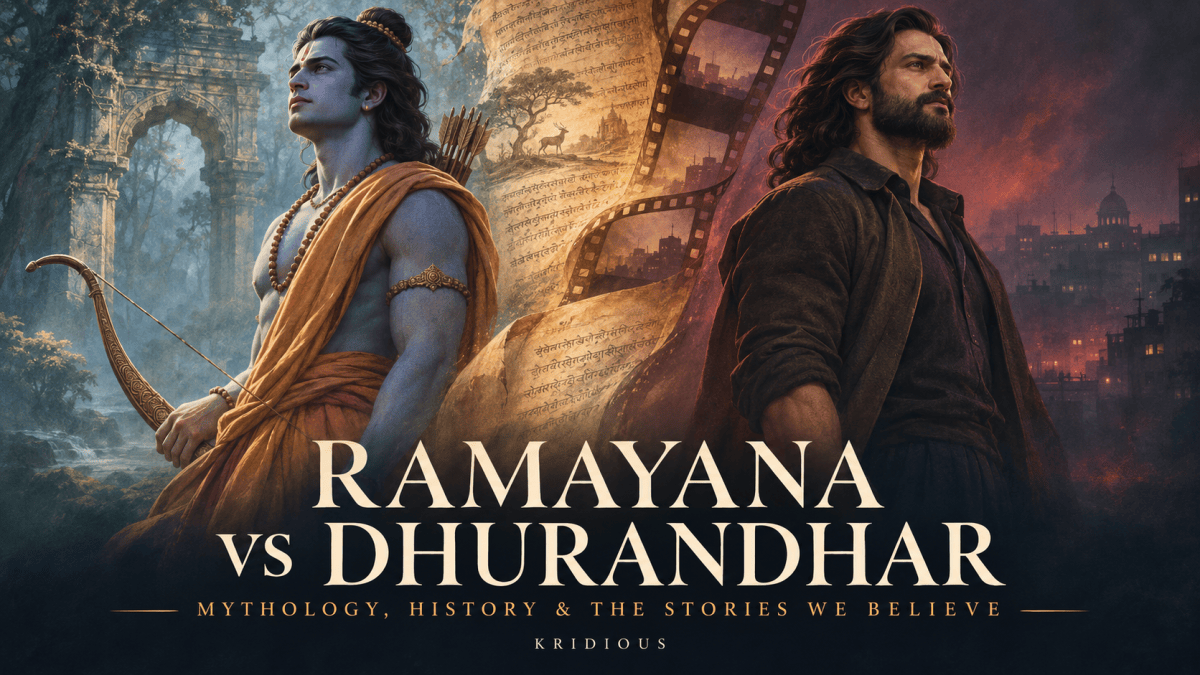
In Indian cinema, that contradiction has found two spectacular expressions: Nitesh Tiwari’s Ramayana and Aditya Dhar’s Dhurandhar duology. One revisits a story that has survived precisely because successive generations found new ways to tell it. The other stitches events from within living memory into an audacious universe of espionage, political intrigue and revenge.
Both are immense cinematic undertakings. Both demonstrate technical ambition of a kind Indian filmmakers can rightfully celebrate. And both deserve to be judged as films, including for the liberties they take.
READING NOTES
Genre
Cultural commentary
Themes
Mythological adaptation, historical fiction, audience scrutiny
Format
Long-form essay with source notes
Access
Free to read
“The problem is not creative freedom. It is our selective appetite for truth.”
02 / THE ARGUMENT
Why does one story demand fidelity while another invites invention?
“The first difficulty with demanding that Ramayana adhere to the ‘original’ is deciding what we mean by that word.”
The story has travelled across languages, regions and traditions. It has endured through retelling, reinterpretation and debate.
What changes when historical fiction borrows the authority of real events? Why do we apply different standards to a contemporary thriller and an ancient epic?
This preview presents the original essay’s central questions, not additional historical claims.
03 / EDITORIAL ELEMENTS
More than a wall of text.
A premium reading template can give visitors a clear visual hierarchy and optional context without interrupting the article.
What is the essay asking?
It asks why audiences sometimes demand strict textual fidelity from mythology while accepting far-reaching liberties when films dramatise events from recent history.
Where are the citations and references?
The published article contains an original sources-and-further-reading section. This prototype links to that source rather than reproducing a second, independently maintained bibliography.
What is different from the current reading layout?
Full-bleed editorial illustration, lighter reading paper, a dedicated pull quote, side notes, section hierarchy and mobile-friendly in-page navigation.
READ THE ORIGINAL · FULL TEXT & SOURCES
The conversation continues.
Read the complete essay in its published form, including its detailed arguments and source notes.

