
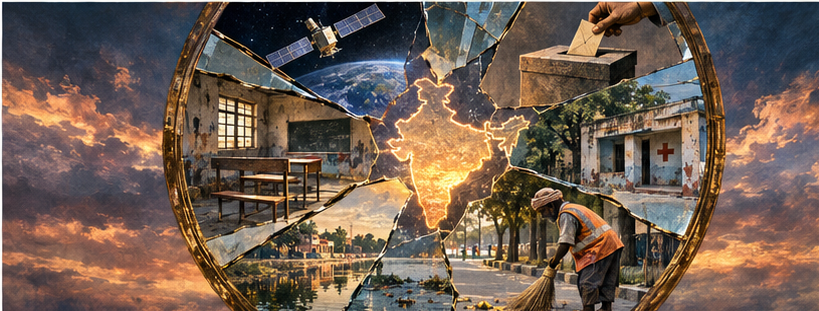
A sequel to Pandemonium Ferrate: The Moods of Man (2016). An essay on the selective application of virtue, reason, merit and patriotism.
By Rishabh Dubey ‘Kridious’
A decade ago, in Pandemonium Ferrate: The Moods of Man, I contemplated the idiosyncrasies of mankind through the chronology of its evolution. The irony of a civilisation celebrating its Martian endeavours whilst consulting the position of Mars to determine the matrimonial prospects of its children was one such observation. Ten years hence, machines have begun to emulate human intellect, and we have accumulated an unprecedented quantity of information. Whether the species has acquired wisdom in corresponding proportions remains a matter of considerable speculation.
For the purposes of this sequel, let us confine our observations to a particularly fascinating specimen of civilisation: a republic that celebrates its antiquity whilst aspiring towards futurism, professes its diversity whilst meticulously preserving its divisions, and prides itself upon its scientific accomplishments whilst remaining susceptible to the allure of superstition. It is a republic in which many of us appear to have developed a remarkable ability to accommodate two incompatible convictions without experiencing the slightest intellectual discomfort. Let us commence, appropriately enough, with the institution entrusted with governing us.
IN THIS ESSAY
- I. The Dynasty of Anti-Dynasts
- II. The Arithmetic of Progress
- III. Mera Gadha, Gadhon Ka Leader
- IV. The Gods of a Dying Earth
- V. The Unread Scriptures and the Blasphemy of Progress
- VI. Brotherhood Until Marriage: The Condescension of Equality
- VII. The Meritocracy of Birth and the Arithmetic of Scarcity
- VIII. The Patriot and His Plastic Bottle: Upon the Shoulders of the Unseen
- IX. The Privatisation of Survival and the Republic That Exports Its Intellect
- X. The Pandemonium Within
- References and further reading
I. The Dynasty of Anti-Dynasts

The foremost champions of cultural nationalism frequently invoke the ethical ideal of the reign of an ancient prince of the Solar dynasty. One of their principal objections to the grand old political institution of our Republic, meanwhile, is the inheritance of political power. The grand old institution professes democracy, liberty and equality, yet has repeatedly confronted the question of hereditary influence within its own organisation. Neither the epic nor the criticism is intrinsically contradictory: an ancient monarchy can inspire an ethical vision of justice without prescribing the inheritance of modern public office. It is the selective application of the principle that warrants attention.
According to a 2025 analysis by the Association for Democratic Reforms (ADR), roughly one in five sitting legislators across Parliament and state legislatures had a dynastic political background. The proportions among the grand old institution and its principal national rival were approximately 32% and 17%, respectively, in the original ADR dataset. [1] These figures describe family connections, not the competence or motives of every individual concerned. A politician’s child may be an exemplary public servant; a person without political ancestry may be an exceptionally poor one. But if we condemn inherited access to power as a principle, we ought to apply that principle regardless of the party exercising it.
Consider another peculiar feature of our electoral machinery. Of the 543 members elected to the Lok Sabha in 2024, 251 declared criminal cases in their election affidavits. Candidates with declared cases had a winning rate of 15.3%, against 4.4% for those without such declarations. [2] A pending case is not a conviction, and allegations can be politically motivated; the figures cannot establish why voters chose particular candidates. Yet surely it is reasonable to ask why the institutions that formulate our laws do not face a stronger collective incentive to select candidates with demonstrable integrity.
The citizen is obliged to explain the sources of his income; the institutions competing for his vote, under a scheme subsequently invalidated by the Supreme Court in February 2024, were once permitted to receive political contributions without disclosing the donors’ identities to the electorate. [3] Nepotism, opacity and impropriety are apparently most recognisable to us when practised by somebody else’s political establishment. The republic is not absolved of these contradictions merely because its citizens elect those who govern it. In fact, that is precisely why the contradictions are ours.
II. The Arithmetic of Progress
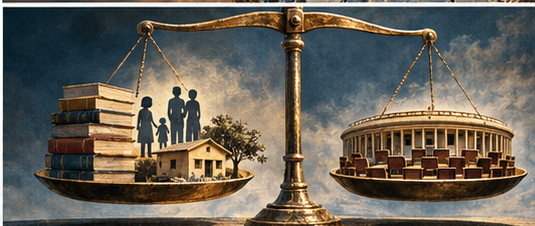
There was a time when the Republic, quite correctly, encouraged its citizens to educate their daughters, improve maternal and child health, and exercise demographic restraint. Governments spent decades promoting family planning. Different regions underwent demographic transition at different rates. The National Family Health Survey of 2019–21 placed the total fertility rate at 2.0 children per woman nationally, 3.0 in Bihar, and 1.8 in both Kerala and Tamil Nadu. [4]
Now imagine two provinces instructed by their common administration to moderate population growth. The first manages to do so, assisted by a convergence of education, healthcare, economic circumstances and access to reproductive choices. The second undergoes that transition more slowly. If future parliamentary influence is allocated purely in proportion to their populations, the former may find its relative political voice reduced precisely because its population grew less rapidly. We have arrived at an unusually interesting question: can the consequences of demographic progress become a political disadvantage?
There is, of course, an equally compelling argument on the other side. A citizen born in a more populous or less prosperous state is no less entitled to representation than one born elsewhere. Democracy cannot assign a premium to an individual’s vote merely because the state of his birth has a higher per capita income. Nor are fertility differences an adequate measure of intelligence. The conditions under which families make reproductive decisions are complex; poverty, access to healthcare, women’s autonomy, infant mortality and employment all matter.
As of 28 November 2026, the matter is particularly topical. A revised constitutional amendment proposal approved by the Union Cabinet on 27 November would expand Lok Sabha seats across states by 50% while preserving the relative allocation among states until 2051. This followed an unsuccessful earlier legislative attempt and remains a proposal, not an enacted nationwide redistribution. [5] Its approach addresses an important element of the federal concern, although the broader question of future representation remains.
The dilemma is not a contest between supposedly superior and inferior populations. It is between the equal political dignity of every citizen and the legitimate aspiration that states should not be penalised for achieving objectives collectively prescribed by the Republic. A durable resolution requires both principles to be acknowledged rather than one population being blamed for the circumstances of another.
Perhaps the true absurdity is that we devote so much energy to debating the distribution of our political influence, and rather less to ensuring that every child, regardless of the geography of his birth, enjoys the conditions under which demographic progress becomes possible. A seat in Parliament is important. So is a seat in a classroom. The latter may do rather more to determine what the former shall mean to our descendants.
III. Mera Gadha, Gadhon Ka Leader
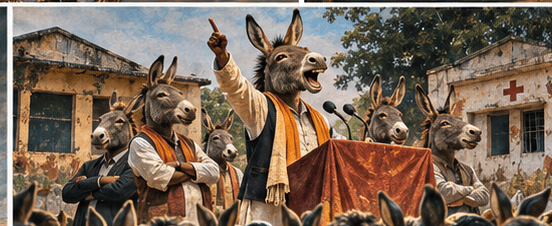
Permit me, for a moment, a departure from human civilisation. There once existed a democratic republic of donkeys. Every few years, the donkeys elected one amongst themselves to administer their magnificent republic. In principle, the exercise concerned the quality of their fodder, the condition of their stables, the education of their offspring, the efficacy of their veterinary services and the maintenance of the paths upon which they travelled.
In practice, elections occasionally degenerated into a rather different exercise. A donkey’s principal concern became ensuring that his preferred donkey defeated the donkey preferred by his neighbour. The latter’s misdeeds were carefully catalogued, whilst the shortcomings of his own were either denied, justified or attributed to the donkey that had preceded him. The election ceased to be an appraisal of governance and became a referendum on the collective egos of the respective herds.
Mera gadha, gadhon ka leader!
The aspiring leaders, in this little fable, gradually discovered that appealing to the anxieties, affiliations and prejudices of their constituents could require considerably less effort than repairing a stable or establishing a school. Those constituents who enquired about the missing schoolteachers were informed of an insult committed against their ancestors. Those who asked about the veterinary clinic were reminded of the shortcomings of a previous administration. Those who questioned their own preferred leader were viewed with considerably greater suspicion than those who questioned a rival.
And thus the donkeys congratulated themselves upon the victory of their respective donkeys, whilst the paths remained potholed and the stables awaited repair. The donkey in this allegory is not the poor, the illiterate, a particular region, caste or community. He is anyone who exchanges intellectual independence for unconditional political allegiance. A university degree offers no immunity to this affliction.
It would, nevertheless, be unfair to conclude that Indians do not want development. A nationwide ADR survey conducted in 2018 placed better employment opportunities (46.8%), healthcare (34.6%), drinking water (30.5%), roads (28.34%) and public transport (27.35%) among the leading concerns of respondents. [6] The survey did not establish that these priorities always determine the eventual vote. Voters weigh a variety of competing considerations, including security, social identity, economic need, local representation and trust. The question is why the perfectly legitimate demands for basic services can lose prominence amid the spectacle of electoral competition.
We need not counsel our fellow citizens into accepting our preferred ideology. We need to cultivate their capacity to question every ideology, including our own. Civic education ought to teach a citizen how a budget works, which authority maintains his road, how a hospital is financed, how to distinguish a manifesto from an achievement, and why a representative owes him accountability rather than personal favour. The well-educated and economically comfortable are not exempt from that education.
Nor should the provision of welfare be confused indiscriminately with the manufacture of dependency. Nutrition, healthcare, social protection and education may give citizens the material freedom to exercise their political rights. The distinction lies in whether assistance expands individual agency and opportunity or is made conditional upon gratitude and allegiance. The public treasury is not the personal beneficence of its temporary administrator. A citizen accepting public assistance owes no political master his vote.
A democracy is not merely the freedom to choose one’s leader. It is also the freedom to discover that one’s choice was mistaken, to say so, and to demand better without forfeiting one’s membership of the herd.
IV. The Gods of a Dying Earth
Our Republic is home to religious traditions of extraordinary antiquity and philosophical diversity. Amongst the concepts recurring across many of them are compassion, restraint, respect for creation and a recognition that human existence is inseparable from the natural world. It is in the application of these concepts that our species occasionally becomes fascinating.
An adherent of the predominant religious tradition might protest the ritual slaughter of animals associated with the Republic’s largest religious minority, and might have a perfectly legitimate ethical objection. Another citizen may regard animal sacrifice as permissible when performed within his own tradition. Yet the same principle of compassion demands scrutiny of sacrificial practices wherever they occur, including within the predominant tradition, and of the cruelty inherent in non-ritual commercial practices. The animal does not enquire into the theological credentials of the individual responsible for its suffering.
The Prevention of Cruelty to Animals Act, 1960, even contains a provision, Section 28, protecting methods of killing animals required by a community’s religion from constituting an offence under that Act; other applicable legal restrictions may still operate. [7] The distinction between a legal exemption and an ethical justification is worth preserving. An act permitted by law is not necessarily an act beyond moral enquiry.
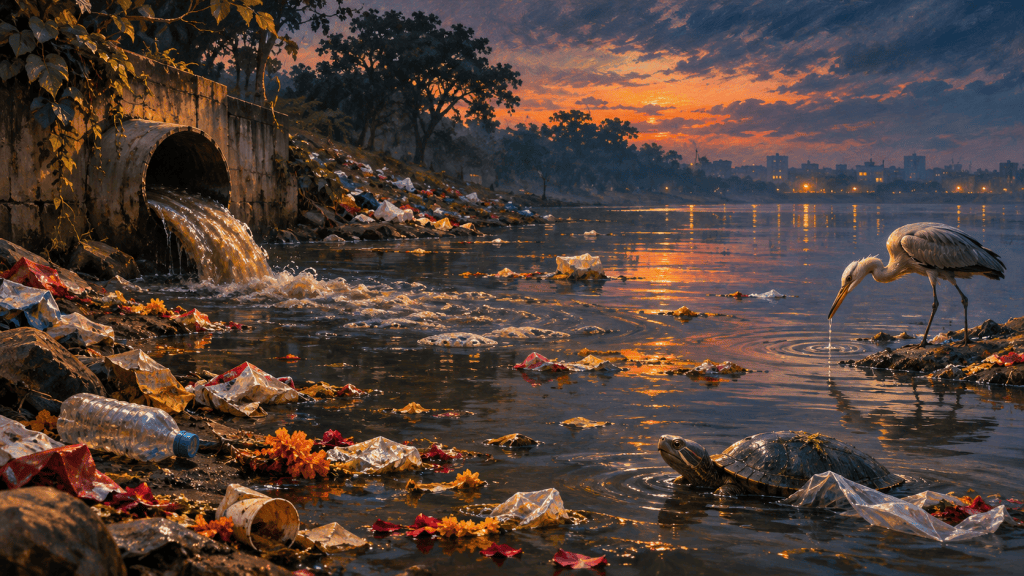
Then there is the river. We elevate a river to the status of a mother, immerse offerings in it to express our reverence, and on occasion leave behind materials that compromise its ecological health. We celebrate the triumph of light with festivities whose emissions can exacerbate the respiratory difficulties of children, the elderly and those already unwell. A study published in 2026 examining festive fireworks in Mumbai in 2022 and 2023 recorded fine-particle concentrations rising by approximately 1.9 to 2.4 times during the studied events. [8] That does not imply fireworks are the sole or principal annual source of Mumbai’s pollution. It does establish that the choice of celebration has measurable consequences. The Central Pollution Control Board has, likewise, developed guidelines for environmentally responsible idol immersion. [9]
The burden of a celebration is not always borne by its celebrants alone. The child with asthma, the animal frightened by the noise, the person recovering from surgery, the worker clearing the debris at dawn and the downstream community receiving the waste may all participate in its consequences without having consented to its practices.
We should preserve the extraordinary ability of festivals to unite people, nourish communities, provide assistance to those in need and make the ordinary experience of life more beautiful. A community festival could be an occasion to restore a lake, plant indigenous trees, reduce waste, care for animals, share a meal with strangers or fund the education of a child. None of these need diminish the beauty of music, light, ritual, prayer or cultural expression.
A river does not distinguish between pollutants deposited in reverence and those deposited in negligence. The lungs of a child do not enquire into the religion of the particulate matter they inhale. If the creator resides within creation, the destruction of creation is a rather peculiar demonstration of devotion.
V. The Unread Scriptures and the Blasphemy of Progress

In 2016, I was amused by the gentleman who celebrated our voyage towards Mars but objected to a marriage on account of the astrological influence attributed to the same planet. I remain amused by the phenomenon, although it has since acquired a somewhat more disconcerting dimension. We have become capable of carrying the accumulated knowledge of civilisation in our pockets, yet the accessibility of knowledge has not necessarily increased our willingness to be corrected by it.
In its 2021 publication on religion in India, based on interviews with nearly 30,000 adults conducted in 2019 and 2020, Pew Research Center reported that 58% of adults read or listened to scripture no more frequently than annually, including 22% who said they never did either. [10] Oral tradition, instruction and lived spiritual experience matter, and these figures do not determine anyone’s knowledge or virtue. They do invite a question about the relationship between conviction and the effort expended in examining its foundations.
There exists a peculiar category of intellectuals who possess unshakeable convictions concerning books they have never opened, an extraordinary hostility towards philosophies they have never studied, and a formidable willingness to defend interpretations they have never questioned. To read a text is not necessarily to comprehend it; to inherit an interpretation is not necessarily to have investigated it. The distinction between scholarship and the defence of one’s identity is particularly important when an interpretation is used to govern the lives of others.
Religion has served human societies as a source of meaning, consolation, moral instruction, social solidarity and metaphysical speculation. It has also, in different periods and traditions, furnished justifications for hierarchy and coercion. Neither history nor reason warrants declaring every religion destined to disappear if it resists reform. Institutions can remain influential despite prolonged orthodoxy. The more important concern is whether their adherents are free to respond to new knowledge and recognise the suffering produced by certain interpretations.
On 4 December 1829, the Bengal Sati Regulation prohibited the immolation of widows within the territories under its jurisdiction. Raja Ram Mohan Roy was among the Indian reformers who opposed the practice. On 14 January 1830, members of an orthodox community in Calcutta petitioned against the regulation, characterising it as interference in religious affairs. [11] Roy and other reformers defended abolition, including through their interpretation of religious sources. The moral dispute was not simply one between religious belief and irreligion; it was also a dispute within a religious tradition over what its beliefs demanded.
Imagine the reformer operating in a society where the hurt sentiment of the defender of a practice is treated as more consequential than the hurt experienced by its victim. The very man we garland today might have been obliged to apologise for questioning a custom we now recognise as indefensible. Indeed, the historical opposition to his reform indicates that this thought experiment is not entirely imaginary.
The descendants of reformers, irrespective of their community, occasionally find themselves condemning the next generation of reformers for exercising precisely the intellectual faculties they admire in their predecessors. We celebrate those who challenged established interpretations, then occasionally demand immunity from criticism for our own. The largest minority tradition, no less than the majority tradition, includes competing interpretations, reform movements and orthodox positions. Its adherents are entitled to equal freedom of conscience, and no interpretation in any tradition is entitled to immunity from ethical and scientific scrutiny simply because it is sacred to someone.
The Constitution of our Republic, rather inconveniently for the advocates of unquestioned belief, includes amongst the duties of citizens the cultivation of scientific temper, humanism and the spirit of enquiry and reform, under Article 51A(h). It also enjoins environmental protection, compassion for living creatures, harmony and respect for women’s dignity. [12] These are not prescriptions for an irreligious nation. They establish a vision of a Republic in which convictions may coexist with the courage to examine them.
The greatest service we can render to the philosophies that have shaped us may not be to defend every historical manifestation of them, but to identify which of their principles remain meaningful and which practices have ceased to be defensible. The capacity to reform a tradition is not evidence that the tradition is worthless. It may be evidence that we value it sufficiently to consider its future.
VI. Brotherhood Until Marriage: The Condescension of Equality
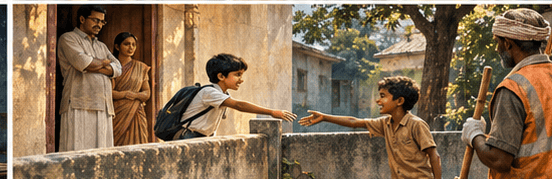
We celebrate the Republic’s diversity on its national days. We speak of universal brotherhood, regard every citizen as an equal in our public declarations, and proclaim our benevolence towards communities other than our own. These splendid convictions can undergo a rather curious metamorphosis when the subject of conversation becomes the marriage of our children.
Pew’s 2021 study found that 84% of Indian adults considered respect for all religions very important to being truly Indian. Yet roughly two-thirds of adherents of the majority tradition considered preventing women from marrying outside their religion very important; the corresponding proportion in the largest minority tradition was 80%. Substantial proportions also opposed interreligious marriages involving men. The same survey found that 70% of adults said most or all of their close friends belonged to their own caste. [13] Friendship patterns are not automatically proof of active discrimination; geography, networks and family environments influence them. But when segregation becomes a norm that must be enforced, tolerance proves to be a rather limited virtue.
We are all brothers and sisters until somebody wishes to marry one of us. A person’s right to choose a partner ought not to depend upon the ability of that choice to preserve his family’s demographic purity. The irony is particularly conspicuous in a society that regards female divinity as the embodiment of knowledge, wealth and power, whilst many of its households remain apprehensive about entrusting women with the administration of their own lives. In the 2024 national Time Use Survey, among participants aged six and above performing unpaid domestic services, women averaged 289 minutes per day, compared with 88 for men. [14] Worshipping the feminine is not the same as equitably distributing the burdens borne by women.
An even more peculiar manifestation of condescension occurs when an individual born into a traditionally privileged caste congratulates himself on treating those born into a historically disadvantaged caste with equality. One wonders what degree of superiority a man must presume himself to possess before he begins to regard equality as an act of benevolence.
Imagine a gentleman who proudly announces that he does not discriminate against anyone on account of caste. His domestic worker’s child arrives at the building in which he lives. Does he encourage his own child to play with that child, to share a meal, to enter the same swimming pool, to celebrate a birthday together? What if the friendship persists into adulthood? The answers may expose more about the gentleman’s convictions than the declarations he makes about social harmony.
Or imagine the gentleman extending his hand to a prosperous visitor, then recoiling from the hand of the person who cleans his surroundings. Hygiene precautions appropriate to handling waste are legitimate, and every worker deserves proper equipment and safe facilities. But a person’s occupation does not render the person impure. The distinction between avoiding contact with hazardous material and avoiding contact with a human being is fundamental.
The India Human Development Survey of 2011–12, conducted by the National Council of Applied Economic Research and the University of Maryland, found that 27% of surveyed households acknowledged some form of untouchability. [15] That is dated evidence, not a measurement of contemporary prevalence, but it establishes that this was no merely hypothetical social phenomenon many decades after untouchability was constitutionally abolished. Article 17 prohibits it. [12]
A child born to the person who cleans our lavatory may possess the intellectual potential to become the physician who saves our life. The occupation of the parent does not determine the aptitude of the child. If the child of a cleaner is discouraged from sharing a classroom, friendship or table with our own children, we are participating in the reproduction of the very social divisions we profess to have overcome. Equality requires neither our applause nor our permission. It requires that we stop regarding another person’s equal dignity as a concession.
VII. The Meritocracy of Birth and the Arithmetic of Scarcity
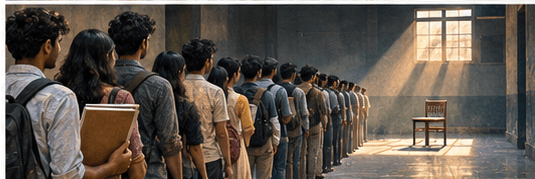
Few subjects evoke such immediate indignation amongst the educated constituents of our Republic as the system of reservation. One frequently encounters a young aspirant who has expended years of arduous effort preparing for an examination, only to discover that he has not secured the position he sought. The disappointment is real. Its consequences for his future may be substantial. It is perfectly legitimate to debate the design, scope, targeting and implementation of affirmative action, and to acknowledge the difficulties encountered by economically disadvantaged people who do not qualify for particular caste-based reservations.
What is rather less defensible is the transformation of the candidate who did secure a reserved seat into the presumed architect of the unsuccessful candidate’s predicament.
Let us first remember why the system exists. Access to education, land, occupations, social networks and positions of authority was historically structured, in significant part, by inherited social hierarchies. The Constitution of 1950 prohibited untouchability and provided for measures addressing inadequate representation in public employment; the First Amendment of 1951 expressly enabled special provisions for the advancement of socially and educationally backward classes, Scheduled Castes and Scheduled Tribes. [12] The ten-year provision originally applied to reserved legislative representation, not to educational and employment reservations generally. Later governments expanded affirmative action in different ways, including measures for other backward classes and economically weaker sections.
Reservation was never intended to create doctors, engineers or administrators by magic. It addresses the unequal access of groups to existing institutions. The aspiration of an evolved society, in my view, should be to create conditions in which such compensatory mechanisms cease to be necessary, rather than to assume that the mere passage of a stipulated number of years has eliminated their causes. That aspiration requires more than additional seats: it requires quality schooling, financial accessibility, freedom from discrimination, meaningful representation, social mobility and periodic evaluation of whether policies reach the intended beneficiaries.
The numbers behind the resentment
Now, for the mathematics. Suppose fifteen lakh aspirants compete for ten thousand seats. Assume, purely for illustration, that fifty per cent of those seats are reserved and the remaining five thousand are open. Five thousand divided by fifteen lakh is approximately 0.33%. Without any reservation, ten thousand divided by fifteen lakh is approximately 0.67%. These are capacity ratios against all aspirants, not a general-category candidate’s personal probability of admission. Open seats are not reserved for a particular caste: eligible candidates from reserved communities may also secure them on open merit. Actual selection depends upon rank, eligibility, counselling preferences and the composition of applicant pools.
What remains unchanged in both scenarios? The number of chairs. We might redistribute ten thousand chairs in a multitude of ways, but fifteen lakh aspirants shall continue competing for ten thousand chairs. Abolishing affirmative action alone would not create the ten thousand and first chair. Doubling capacity to twenty thousand while retaining an illustrative 50% reservation would create ten thousand open seats as well as ten thousand reserved seats. The original argument about scarcity and redistribution is therefore not an argument that competition is painless, but an argument about where additional accountability belongs.
The numbers in real examinations are no less instructive. In 2025, according to the National Testing Agency, 14,75,103 unique candidates appeared for JEE Main Paper 1. The JoSAA counselling system announced 62,853 seats in its participating IITs, NITs, IIITs and other centrally supported institutions. [16] [17] That is around 4.26 seats per hundred JEE Main examinees. This is not an admission probability or a measure of all engineering seats in India: IIT admission has additional JEE Advanced requirements, and many other institutions fall outside JoSAA.
In medicine, 22,09,318 candidates appeared in NEET UG in 2025. A subsequent parliamentary answer reported 1,28,976 undergraduate medical seats across the country. [18] The comparison yields a capacity ratio of about 5.84%, or approximately seventeen examinees for every reported undergraduate medical seat. Some candidates pursue other courses through NEET, and not all seats are equally affordable; the ratio is illustrative, not a forecast of admission. The competition for a financially accessible place can be considerably more constricted than the nationwide inventory suggests.
Capacity, quality and public investment
We can acknowledge the progress achieved in expanding educational institutions without deeming it sufficient. Government figures show that medical undergraduate capacity grew from 51,348 seats in 2013–14 to 1,15,812 in 2024–25. [19] Conversely, NITI Aayog’s examination of UDISE+ data reported that the share of enrolment accounted for by government schools declined from 54.3% in 2014–15 to 49.25% in 2024–25. [20] School consolidation, demographic shifts, private enrolment and state-level decisions complicate the interpretation of these trends; education is a concurrent responsibility. It would be inaccurate to assert that every category of educational institution has contracted under a particular administration. The question for successive governments, central and provincial, is whether quality, accessibility and affordability have expanded sufficiently relative to the aspirations of the Republic.
There is a particularly interesting legislative precedent. Section 5 of the Central Educational Institutions (Reservation in Admission) Act, 2006, provided for expansion of capacity in covered institutions so that introducing additional reservation would not reduce the number of seats previously available outside the specified reservations. [21] The legislature recognised that redistributing scarcity need not be the only response to unequal access. Why should this principle not inform our broader ambitions for public education? Expansion must come with appropriately qualified faculty, laboratories, clinical facilities, accreditation and standards. Twenty thousand chairs without competent teachers would be another variety of statistical triumph and substantive defeat.
Inherited advantage and the inexpensive nanny
Now let us return to the gentleman who prides himself upon meritocracy. Upon the birth of his child, he telephones a relative in his ancestral village and enquires whether a woman might be found to assist in raising the child at a remuneration considerably below what he would consider adequate for his own time. The worker’s availability at that remuneration may reflect poverty, limited access to schooling, gender inequality, caste-based exclusion or other economic circumstances. Not every domestic worker is historically disadvantaged on account of caste, nor is every arrangement exploitative. The point is to investigate the conditions that shape the bargaining power of both parties.
His own child shall receive the finest education his resources can procure. The woman entrusted with raising his offspring may never have received comparable opportunities. Years later, their respective children may sit for the same competitive examination. One may enter it fortified by a quiet study room, private coaching, a personal computer, professional networks and the knowledge of several generations. The other may have overcome difficulties which the examination has no mechanism to measure.
Neither child chose the circumstances of his birth. Both deserve an opportunity. The examination may measure what each has learnt; it cannot, by itself, distinguish aptitude from the sum of opportunities through which aptitude was cultivated. And should the second child obtain the benefit of affirmative action, the gentleman shall lament the demise of meritocracy. He will question the advantages conferred by the Constitution upon the other child, but seldom enquire into the advantages history has conferred upon his own.
The inequalities are not merely anecdotal. A 2024 World Inequality Lab issue brief estimated that the upper-caste grouping, accounting for slightly more than a quarter of the population in its estimates, held nearly 55% of wealth. [22] These estimates are not an exhaustive caste census and do not imply that every individual born into that grouping is affluent. They do provide context for examining the inherited financial and social advantages that a single examination cannot capture.
We have reserved businesses for our descendants, wealth for our descendants, professional contacts for our descendants and, historically, even particular occupations for particular descendants. Private inheritance and constitutional affirmative action are not legally identical, but the former has consequences for the equality of opportunity that the latter attempts to address. To discuss one inheritance without acknowledging the other is an incomplete account of merit.
I would like to inhabit a Republic in which the caste of a child’s parents is irrelevant to his capacity to acquire education, employment or a dignified livelihood. That is the circumstance in which the removal of compensatory provisions can be meaningfully contemplated. Until then, we must resist the temptation to make enemies of young citizens seeking the same thing: an opportunity. The quarrel is between those who seek a chair. The accountability ought also to lie with those entrusted with creating the chairs.
VIII. The Patriot and His Plastic Bottle: Upon the Shoulders of the Unseen

A gentleman drives through the streets of his beloved motherland in a rather magnificent automobile. A patriotic song emanates from its speakers, perhaps accompanied by a miniature national flag adorning its dashboard. He is understandably proud of the progress of his Republic, and may have been particularly vocal that morning in questioning the patriotic credentials of individuals who do not share his political convictions.
He finishes his beverage, lowers the window of his automobile and discards the plastic bottle upon the very soil whose magnificence he has been celebrating. He subsequently drives away.
Somewhere, another citizen, considerably less privileged and perhaps considerably less vociferous about his patriotism, shall bend down to retrieve the bottle. That citizen shall clear the waste of countless other inhabitants, maintain the sanitation of their surroundings and contribute to the prevention of disease amongst people who may never acknowledge his existence.
Of the two, who has served the nation?
It is not an abstraction. In a parliamentary reply reported by the government in 2026, 332 deaths were recorded in eighteen states and Union Territories during hazardous sewer and septic tank cleaning between January 2021 and June 2026. [23] These were deaths associated with hazardous cleaning, not simply a general measure of street-cleaning fatalities. Hazardous manual sewer cleaning is prohibited, and the government has instituted programmes for mechanisation, protective equipment and rehabilitation. The deaths nonetheless occurred. If our commitment to the dignity and safety of our fellow citizens is genuine, mechanised sanitation, accountable contracting, training, protective measures and alternative livelihoods deserve the same passion we expend on declarations of national pride.
The invisible labour behind success
Consider now the popular expression, self-made. I have considerable admiration for the perseverance required to emerge from challenging circumstances and achieve something substantial. But self-made, taken literally, is perhaps amongst the least accurate descriptions of any modern human being.
The house we inhabit was constructed by hands we may never have shaken. The water we consume arrives through pipes maintained by people whose names we may never have learnt. Our clothes, roads, transport, electricity, food and sanitary surroundings are the products of an extraordinary and largely invisible web of collective effort. Even the hours we devote to our own ambitions may be made available by someone else’s labour. In the more comfortable households of the Republic, the person responsible for that labour may receive a fraction of the remuneration we demand for an hour of our own professional expertise.
The International Labour Organization has documented challenges involving wages, formalisation, working conditions and access to social protection in India’s domestic work sector. [24] Paid domestic work can be an honourable and mutually beneficial occupation. The concern is not that a household hires assistance, but that the vulnerability of the worker may become the basis upon which the household negotiates the value of her time.
Why does that person perform the work she performs? What opportunities were available to her parents, her grandparents and the generations that preceded them? What was the history of her family’s access to land, education, dignified employment and freedom from discrimination? The answers will vary. Some may reveal entrepreneurial choice, others constrained choices, and others a lineage of exclusion. We owe each person the courtesy of recognising her agency without assuming that the circumstances she inherited were of her own making.
We have leapt over the walls that once confined us, ascended the summits of our respective ambitions, and proudly proclaimed ourselves to be self-made. In the exhilaration of our ascent, however, we have conveniently forgotten the shoulders upon which we placed our feet.
The people who washed our utensils, laid our bricks, carried our refuse and cared for our children rarely feature in the autobiographies of our successes. They remain the unacknowledged variables in the equations of our prosperity. It is not an insult to the accomplished to recognise their interdependence with the less celebrated. It is an invitation to gratitude, and, more importantly, to fair compensation and dignity.
IX. The Privatisation of Survival and the Republic That Exports Its Intellect

An interesting consequence of prosperity in a society with uneven public infrastructure is that prosperity can increasingly be utilised to protect oneself from the shortcomings of that infrastructure. If the local school is inadequate, a household with resources may choose a private school. If the public hospital is overcrowded, it may purchase private healthcare. If the buses and trains are inconvenient, it may buy an automobile. If public space is unpleasant, it may pay to inhabit a gated community. If the air is polluted, it may purchase a purifier.
None of these choices is necessarily unreasonable. A parent is entitled to seek the best available education and healthcare for a child. But the aggregate consequence can be a society in which those possessing the greatest capacity to demand institutional improvement have comparatively little personal incentive to do so, whilst those who depend most upon these institutions have fewer resources with which to exert that influence. This is a possible mechanism, not an immutable rule: many affluent citizens actively support public institutions, and many disadvantaged citizens exercise substantial political agency.
The poor are often compelled to endure the inadequacies of public institutions. The affluent may purchase insulation from some of them. And some of those possessing internationally marketable skills may purchase a ticket elsewhere.
According to the OECD’s International Migration Outlook 2026, India remained the largest origin country for migration flows to OECD countries in 2024, despite a substantial annual decline. [25] The data encompass a variety of migrants, not exclusively highly educated professionals. Migration is shaped by salaries, research facilities, education, professional mobility, family circumstances, immigration rules, quality of life and countless individual aspirations. It is neither accurate nor fair to imply that every talented emigrant departs because of political dissatisfaction, or that those who remain are somehow less talented.
Nevertheless, we frequently celebrate the Indian origin of a scientist who contributes to research overseas, a physician who transforms healthcare in another country, or an entrepreneur who builds an extraordinary enterprise abroad. We are entitled to be proud of such achievements. What we might contemplate with comparable enthusiasm are the circumstances that determine whether an ambitious scientist can pursue an equivalent vocation at home, whether a physician can serve in a well-equipped public institution, and whether an entrepreneur can build without insurmountable obstacles.
The benefits of migration are real: families receive remittances, knowledge circulates across borders, businesses and research networks develop, and people sometimes return with additional skills. A human being is not an asset belonging to the state in which he was born. The objective should not be to shame the emigrant into remaining, but to make the decision to remain a viable and attractive one. That requires institutions capable of rewarding talent, protecting freedom of enquiry and enabling an ordinary citizen to lead a dignified life.
There is an ancillary irony. We occasionally celebrate the patriotism of an expatriate who admires his motherland from afar, yet question the patriotism of a resident who concerns himself with its shortcomings. Admiration from a distance appears, in such instances, more palatable than concern from within. A citizen who demands reliable transport, effective public education, clean air, freedom of conscience and responsive healthcare may be expressing his attachment to the country rather than his contempt for it.
The Republic does not need every citizen to agree upon the same version of its past or the same vision of its future. It needs sufficient common ground upon which to ensure that children are educated, patients are treated, workers are protected, roads are maintained, rivers are clean and those who aspire to achieve something extraordinary need not consider leaving as their only credible means of doing so. These are not the exclusive aspirations of any party, region, class or religion. They are the ordinary necessities of civilisation.
X. The Pandemonium Within

It would be convenient to conclude this discourse with an elaborate denunciation of politicians, religious authorities, historical privilege or an allegedly ignorant electorate. That would place the burden of the Republic’s contradictions comfortably upon someone else’s shoulders. It would also render this essay an additional example of the phenomenon it seeks to examine.
For the religious man identifies the fallacies of another religion. The political enthusiast identifies the corruption of another political establishment. The affluent man identifies the indolence of the impoverished. The educated man identifies the ignorance of the uneducated. And each, whilst exhaustively identifying the inadequacies of others, finds himself with remarkably little time to contemplate his own.
I am no exception to this human proclivity. The questions raised here ought to be directed as much towards the individual writing these words as towards anyone reading them. What do I demand of a leader I admire? What questions do I permit myself to ask of the traditions I inherited? How do I value the time of someone whose labour makes my own life more convenient? What do I do when a right I profess to support becomes personally inconvenient? And what degree of intellectual humility do I retain when the evidence contradicts a conclusion I have already reached?
Perhaps a nation’s progress can also be evaluated by questions that rarely feature in its celebrations of grandeur. Can a child born to a sanitation worker realistically become a scientist? Can a woman exercise the freedom we celebrate in our goddesses? Can a person choose a spouse without the approval of a caste or religious hierarchy? Can a citizen criticise an elected representative without being presumed to have betrayed the country? Can the family that does not possess wealth afford the education, medical attention and mobility necessary to acquire it? Can a man observe a river, a forest or an animal and recognise something worthy of compassion independently of its significance to his own faith?
The Constitution provides us with a vocabulary for addressing many of these questions. Science provides us with methods for distinguishing belief from demonstrable fact. History provides us with a repository of mistakes and achievements. Democracy provides us with a mechanism for correcting the administration of our collective affairs. None of these instruments can compensate for our reluctance to apply their principles to ourselves.
We have confused qualification with education, ritual with devotion, proclamation with patriotism, self-sufficiency with success, and the liberty to possess an opinion with the infallibility of that opinion. We have mistaken the triumph of our favourite donkey for the improvement of his stable. We have argued over the distribution of a solitary chair without contemplating the construction of another. We have climbed to considerable heights without acquainting ourselves with those whose shoulders enabled the ascent.
The true measure of a civilisation’s advancement, perhaps, is not the sophistication of its inventions, the antiquity of its traditions or the magnificence of its monuments. It is the consistency with which it applies its professed virtues, particularly when their application becomes personally inconvenient.
A decade ago, I called the idiosyncratic amalgamation of the moods of man a compound: Pandemonium Ferrate. Ten years hence, I find no shortage of the ingredients that constitute it. There is, nevertheless, reason for optimism in our ability to identify them. A contradiction recognised is not yet a contradiction resolved, but it is a contradiction we can finally begin to address.
Until then, the Republic remains a rather magnificent specimen of the human condition. Complex. Confusing. Contradictory. And, fortunately, still capable of reform.
References and further reading
Sources consulted on 28 November 2026. The statistical comparisons are illustrative and use the populations and dates specified in the text. The allegories are fictional; the illustrations are AI-generated editorial artwork, not documentary photographs.
[1] Association for Democratic Reforms (2025). Analysis of Sitting MPs, MLAs and MLCs in India with Dynastic Political Backgrounds. View source ↗
[2] Association for Democratic Reforms (2024). Lok Sabha election affidavit analysis: criminal cases of newly elected MPs. View source ↗
[3] Supreme Court of India (2024). Landmark judgment summaries: electoral bonds. View source ↗
[4] Reserve Bank of India. Handbook of Statistics on Indian States, total fertility rates; NFHS-5 figures also reported in the Economic Survey 2025–26, Statistical Appendix, Table 8.18. View source ↗
[5] The Indian Express (27 November 2026). Revised delimitation and women’s representation proposal; seat allocation and freeze. View source ↗
[6] Association for Democratic Reforms (2019). National voter survey, governance priorities, 2018. View source ↗
[7] Wildlife Institute of India. Prevention of Cruelty to Animals Act, 1960, Section 28. View source ↗
[8] Atmospheric Environment (2026). Stark variations in the impacts of Diwali fireworks on aerosol characteristics and aging: Influence of festival timing, meteorology, transport and emissions. View source ↗
[9] Maharashtra Pollution Control Board. CPCB guidelines for idol immersion. View source ↗
[10] Pew Research Center (2021). Religious practices in India. View source ↗
[11] George Mason University, Women in World History. Primary source: petition against the Suttee Regulation, 14 January 1830. View source ↗
[12] Constitution of India. Articles 15, 16, 17, 46 and 51A; India Code consolidated text. View source ↗
[13] Pew Research Center (2021). Religion in India: Tolerance and Segregation. View source ↗
[14] Ministry of Statistics and Programme Implementation (2025). Time Use Survey 2024, Table 2, average time per participant aged six and above. View source ↗
[15] National Council of Applied Economic Research. Mapping Exclusion; India Human Development Survey 2011–12. View source ↗
[16] National Testing Agency (19 April 2025). JEE Main 2025 Paper 1, unique candidates appearing across both sessions. View source ↗
[17] Careers360 (2025). JoSAA counselling capacity, 62,853 seats. View source ↗
[18] Ministry of Health and Family Welfare (2026). Lok Sabha Unstarred Question 5700: medical seats and NEET UG candidates. View source ↗
[19] Press Information Bureau (2024). Medical education expansion, MBBS capacity since 2013–14. View source ↗
[20] NITI Aayog (2026). School Education System in India: temporal analysis of UDISE+ 2014–15 to 2024–25. View source ↗
[21] Central Educational Institutions (Reservation in Admission) Act, 2006, Section 5: mandatory increase of seats. View source ↗
[22] World Inequality Lab (2024). Towards Tax Justice and Wealth Redistribution in India, issue brief. View source ↗
[23] Press Information Bureau (2026). Parliamentary reply: 332 sanitation worker deaths during hazardous sewer and septic tank cleaning, January 2021–June 2026. View source ↗
[24] International Labour Organization (2026). Fifteen years of advancing decent work for domestic workers in India. View source ↗
[25] OECD (2026). International Migration Outlook 2026, Executive Summary. View source ↗


Leave a Reply